Art and Fear: How to make art in spite of all your anxieties
I’ve been painting for 16 years and I still get scared not to ruin a painting. Not exactly the master painter I imagined I be. So when the anxiety train hits I just stare at the painting, look around the room and scroll through my phone. Time flies by and often you won’t see anything get done.
7/2/20264 min read
The First Time Fear Won
The first time fear froze me was about 15 years ago. I didn't know how to paint a storm. I tried once, hated the result, threw it away and didn't paint again for six months.
Big mistake. If I could go back, I'd tell myself: don't throw paintings away. Overpaint them. Start again on the same canvas. But don't quit.
Fast forward to today, and the same fear still shows up every week. I look at works in progress and think: this is too hard, I'm going to ruin it. Spoiler, I never do. But the fear still comes anyway.
Here's what I've learned: it's better to make an intentional bad mark and fix it later than to stare at a blank canvas hoping the fear will pass on its own. At least you're moving. And sometimes that "mistake" ends up being the best part of the painting.
What Michael Jordan and a Pottery Class Have in Common
Michael Jordan once said he missed more than 9,000 shots in his career. He lost almost 300 games. Twenty-six times he was trusted to take the game-winning shot and missed. And he still became Michael Jordan. Failure wasn't the opposite of his success. It was the path to it.
There's a similar story I love from the book Art and Fear by David Bayles and Ted Orland. A ceramics teacher split his class into two groups. One group was told they'd be graded purely on quantity, fifty pounds of pots would get an A, forty pounds a B, and so on. The other group was told they'd be graded purely on quality, they only had to produce one, perfect pot.
Guess who made the better work?
The quantity group. By the time grading came around, they'd made so many pots, and learned from so many mistakes along the way, that their best pieces outclassed anything the "perfectionist" group had made because that group had spent the whole time theorizing about perfection instead of actually making anything.
Consistency beats perfection. Every time.
Fear Is Not a Bug — It's a Feature
I might have stolen that line from a business podcast I watch (I need to learn marketing to make this whole art thing sustainable, but that's a story for another day).
Still, it's true. Fear is everywhere in life, not just in the studio: your first day at school, talking to someone you like, public speaking, big decisions. You'll always find something to be scared of. And honestly — you don't want to be fearless. That would make you a psychopath.
Seneca said we suffer more in imagination than in reality. He was right. Most of the time, the thing you're scared of isn't even real. It's a ghost you built yourself, out of worry and lost sleep, for a disaster that never happens.
Fear isn't the enemy. It's your brain's way of telling you that you care about something. The goal was never to eliminate it. The goal is to learn to work with it.
The Existential Version of Fear
Recently I read Kierkegaard's Fear and Trembling. Doesn't sound like a party book — unless you're Danish, or an existentialist. His point was simple: doubt and fear are part of being human. We can't escape them. (Thankfully, none of us have to throw our sons off a mountain like Abraham did or do we?, in our own smaller ways?)
Jung would say something similar: anxiety is archetypal. It's the eternal struggle between doing and hesitating, and it plays out in the studio every single day.
You stand in front of a canvas, and you hear two voices. One says: go for it, put the mark down. The other says: what if it's wrong? What if it ruins everything?
That inner dialogue, that's the archetype of fear.
And the leap, what Kierkegaard called the leap of faith is to act anyway, with no guarantee. That's what painting really is: faith without certainty. Brushstroke after brushstroke, it's a practice in accepting doubt and doing it anyway. And at some point, you look up, and you're happy with what you made.
How to Actually Move Through It
So what do you do when fear sits down next to you in the studio? You don't fight it. You play with it.
Sometimes I grab a random brush, or a color that makes no sense, and I just make a mark, out of pure curiosity, no plan attached. Sometimes it looks stupid. Sometimes it opens a door to something good. Both outcomes are fine.
That's the trick: you don't wait for fear to disappear before you start. You move with it, not after it.
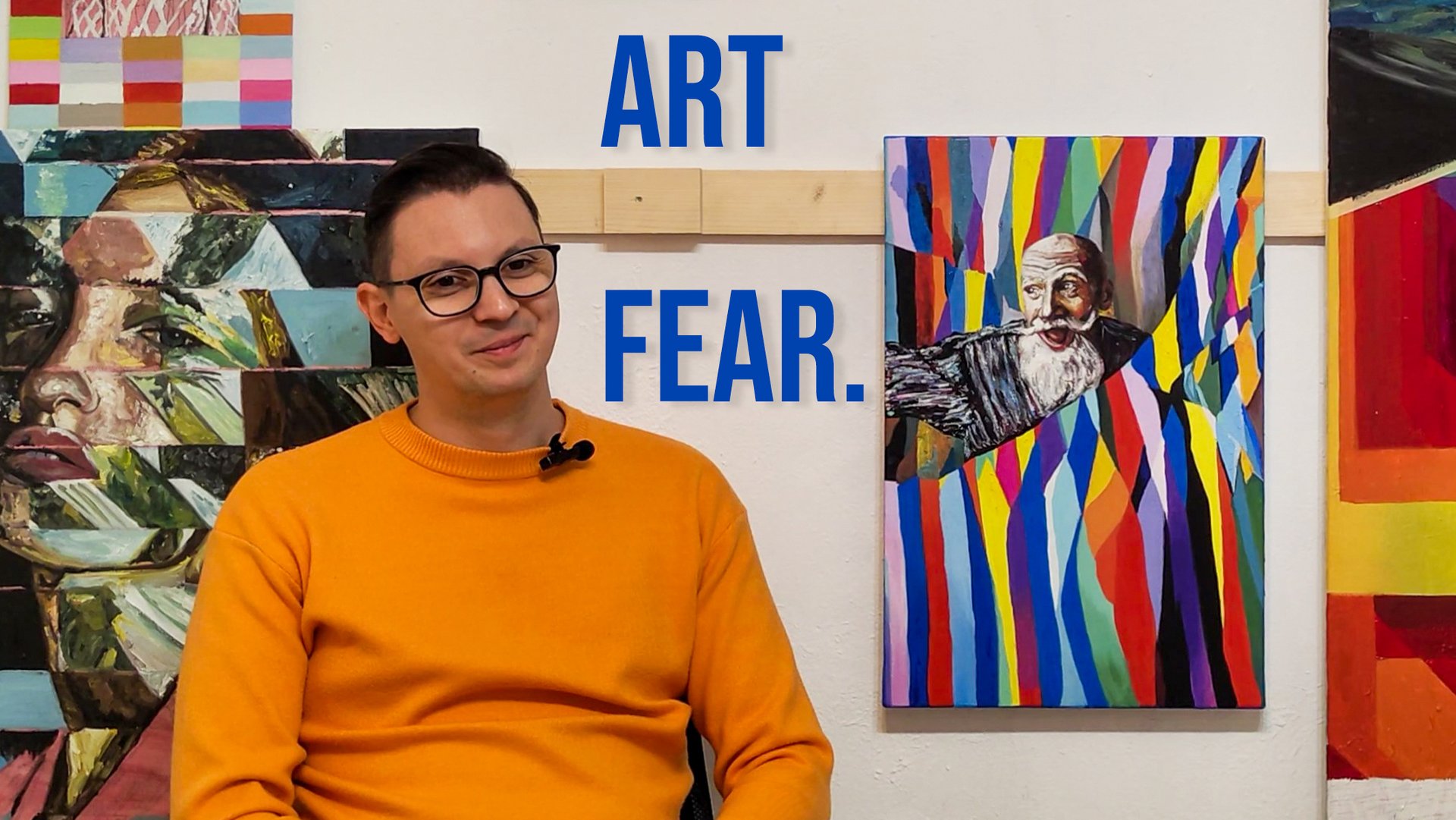
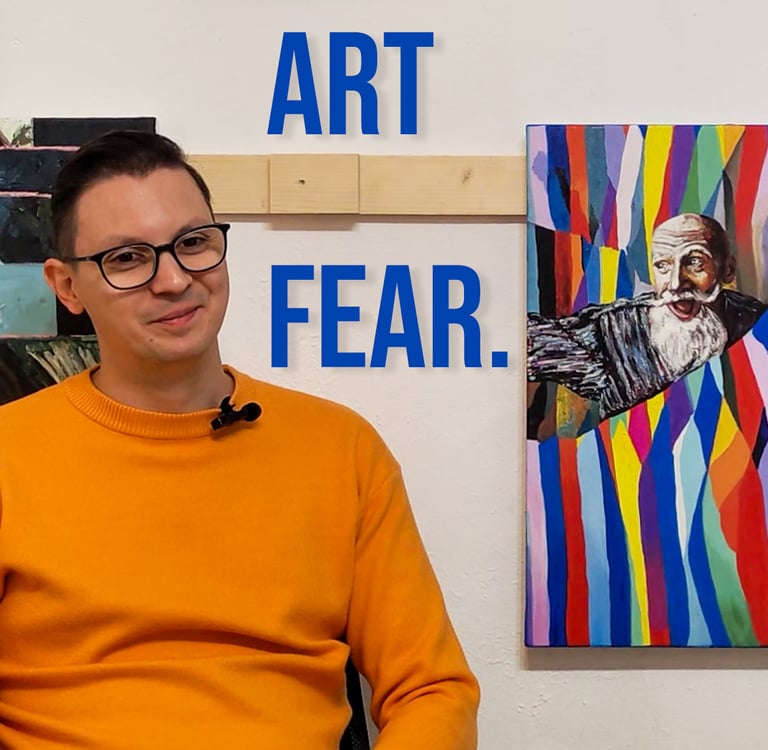
I also lean into absurdity on purpose, a laughing old man surrounded by stripes, colors that "shouldn't" work together. That absurdity is a kind of freedom.
And then there's resilience, which I learned from running, not painting. I have torn ligaments in my left knee, and I still run. A marathon was never about removing the pain, it's about building endurance around it. Painting is the same. You don't get rid of the anxiety. You outlast it.
Sometimes I even ruin a canvas on purpose, like a small sacrifice to the god of imperfection. It sounds dramatic, but it's oddly liberating and it's actually where a whole series of abstract, hand-covered paintings I made came from, born out of pure frustration turned into curiosity.
The Trade
Fear won't vanish. Doubt won't disappear. But you can build a practice around them.
In the end, art isn't about avoiding mistakes. It's about creating something beautiful right through them. That's why I paint — not because I'm fearless, but because I'm not, and I keep painting anyway.
So if you're scared of the thing you're making, good. It means it matters to you. And maybe, sixteen years from now, I'll still be here: scared, painting anyway, and still laughing about it.
Not a bad trade.
If this resonated with you, share it with someone who struggles with fear in their own work. And now, if you'll excuse me, I'll go stare at a canvas for another hour before actually painting something or just go watch some cats on Instagram.